

A letter has been sent to the Kennel Club Chairman raising concerns about the sudden introduction of the revised Agility Course Time Matrix (CTM) in July 2025. Competitors argue that the change—implemented mid-season without consultation or transition—has caused confusion, frustration, and a sense of exclusion, particularly for slower dogs and handlers.
The letter highlights five main issues:
- The arbitrary 10-second adjustment disproportionately penalises longer courses, forcing dogs to run faster over greater distances and raising welfare concerns.
- The calculation method does not reflect the diversity of handlers and breeds, undermining inclusivity.
- Immediate implementation prevented competitors from adjusting training or withdrawing from events.
- The changes disadvantage older handlers, those with reduced mobility, and handlers of slower breeds, raising potential discrimination concerns.
- Competitor representation structures may create governance weaknesses and conflicts of interest.
The Kennel Club has taken the first step toward making agility more elitist. The new CTM disproportionately disadvantages handlers with reduced mobility and slower-running breeds, contradicting the KC’s own Strategic Aims and Accessibility Policy. Despite clear evidence of flaws, the KC’s 31 October 2025 statement dismissed these concerns and closed the matter. Given that agility already rewards the fastest, most accurate dog on the day, why introduce changes that risk excluding so many who take part simply for the love of the it?

Following its introduction over 1000 competitors signed a petition asking for a review and hundreds subsequently formed a Facebook group, the Agility Matrix Think Tank, to pool knowledge, experience, and analytical expertise.
Competitors were informed that The Kennel Club developed the CTM using historical performance data spanning five years from Agility Plaza and Showtime Online, with an additional 10 seconds added to each value to make the Matrix more inclusive and moderate variables such as ground and weather conditions and course complexity.
However, from the outset of the CTM’s implementation, it became apparent that the arbitrary 10-second adjustment created inconsistencies—most notably that dogs were being required to run faster on longer courses, an outcome that raised immediate concerns.
Professional analysis by the Think Tank Facebook group has now been carried out on both the matrix itself and The Kennel Club’s stated methodology. The key findings and resulting impact on competitors of this analysis are summarised below:
- The increase in dog speed over greater course lengths is summarised in the below table:
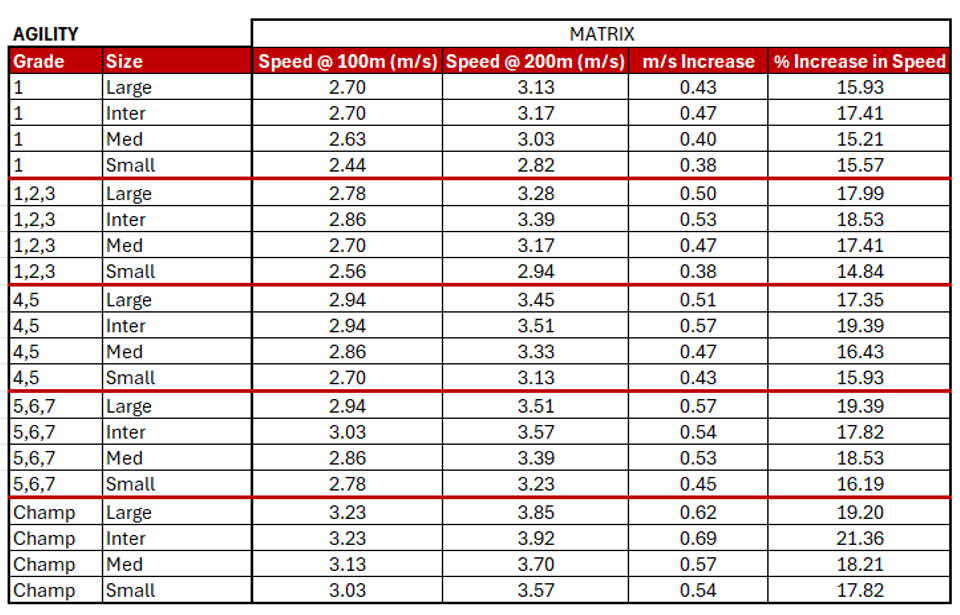
- Under the new CTM, the Metres Per Second for a Grade 1 beginner dog over a 250-metre course is equal to or greater than that required for a more experienced Champ level dog over a 95-metre course.
- Further to the KC’s statement of the 31 October 2025, testing revealed that the matrix favours higher performing dogs, where it was projected that approximately 0.41% of Champs will be outside of the SCT course time, and Intermediate dogs at 16.58%. In contrast, the percentage for exceeding course times are highest in Grade 2 and 3, then gradually decline from Grade 4 (suggesting that Grades 2 and 3 are the most challenging relative to standard course times). The Kennel Club has offered no explanation for this trend and why lower grade dogs are disproportionately affected:
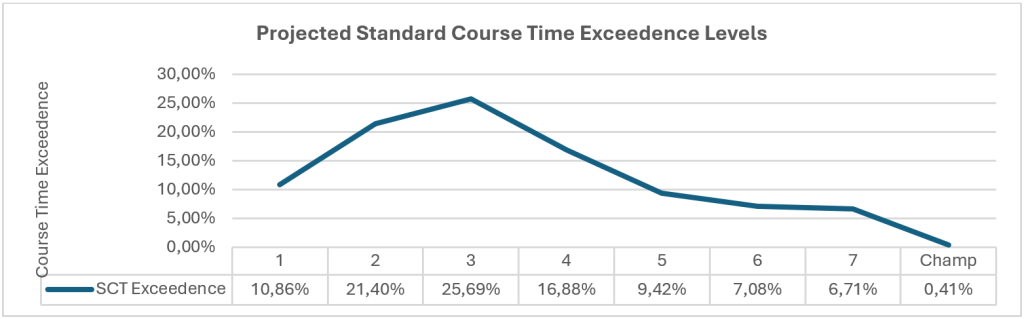
- Small dogs are affected most (29.59%), followed by Medium (28.18%), Large (23.69%), and least affected is Intermediate (16.58%). This demonstrates that the Standard Course Times are skewed in favour of faster dogs (Intermediate (16.58%) and Champ (0.41%) as these are least affected by the new times:

The statement also highlighted that testing of the data set identified that “A total of 8.56% of the data set would have been outside the revised course time matrix, whilst 91.44% remained within the course time using the revised course time matrix, with the lowest possible time given”.
The Kennel Club has not conducted a pre and post implementation impact assessment on the current population of competing dogs to compare against the projected 8.56% – more so as the Agility Liaison Meeting held on 18 June 2025 “considered that the course times were still achievable.” The minutes did not disclose the projected 8.56% that would not meet SCTs, or how the 10 second buffer has or has not minimised this impact.
- As mentioned, The Kennel Club’s statement of the 31 October 2025 stated that they had used a mean average as a base to calculate the Course Time Matrix. If most of those times come from very fast dogs the mean average will be skewed towards their speed. This means the benchmark is set higher (faster), making slower dogs and handlers with physical limitations appear further below the average. As a result, SCTs become less representative of the diverse range of breeds and handler limitations.
- Furthermore, it was stated that “a vast range of dog breeds and handlers’ abilities were included within the data set used”. However, if the core data did not include a unique label to identify dog breed/type and handler age/mobility aligned to every single dog’s course time – it is difficult to ascertain how the impact on inclusivity and breed diversity can be measured.
Also, within the recent Kennel Club communication, it is stated that the matrix will be reviewed at suitable intervals. By applying the same method of calculation time and time again in the future during updates, it will always produce a subsequent matrix which has course times tighter than last, purely because the results will always trend towards the faster breeds of dogs.
It is understood that several methods exist for calculating averages, each with advantages and limitations. However, the Kennel Club has not explained why it selected the mean average.
The core issue is that a mean average treats all data points equally, even though these datasets vary widely between grades and heights and is therefore not suitable for agility. More suitable methods—such as weighted averages—reflect the uneven distribution of runs and ensure that course times are proportionate to each height and grade. Approaches tested by competitors using more appropriate averages have shown that greater inclusivity can be achieved by managing outliers and using percentile-based calculations.
This produces a fairer matrix that adjusts times gradually and avoids the current flaw where dogs must run faster on longer courses. It reduces bias toward the fastest breeds and supports greater diversity in both dogs and handlers.
Some competitors are unconcerned because their dogs are not currently affected. However, if the same methodology used in July 2025 continues to be used in future reviews, course times will become increasingly tighter, eventually impacting many more participants—even those with today’s fast dogs.
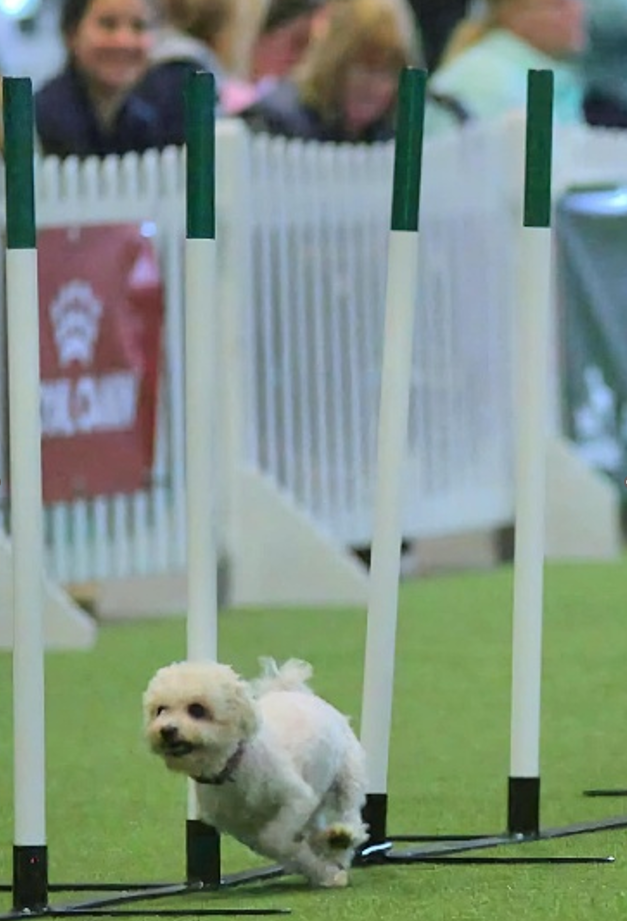
A clear example of the impact is dogs like Dizzy, who competed at Crufts this year and reached the highest grade. Under the new CTM, she would not have been able to progress to that level, with her handler effectively being told they are not good enough to continue.
This is a guest post by Lorraine Matthews. Want to write for us? Visit www.dogstodaymagazine.co.uk/essay-submission or email editorial@dogstodaymagazine.co.uk.


 in July 2025.)