

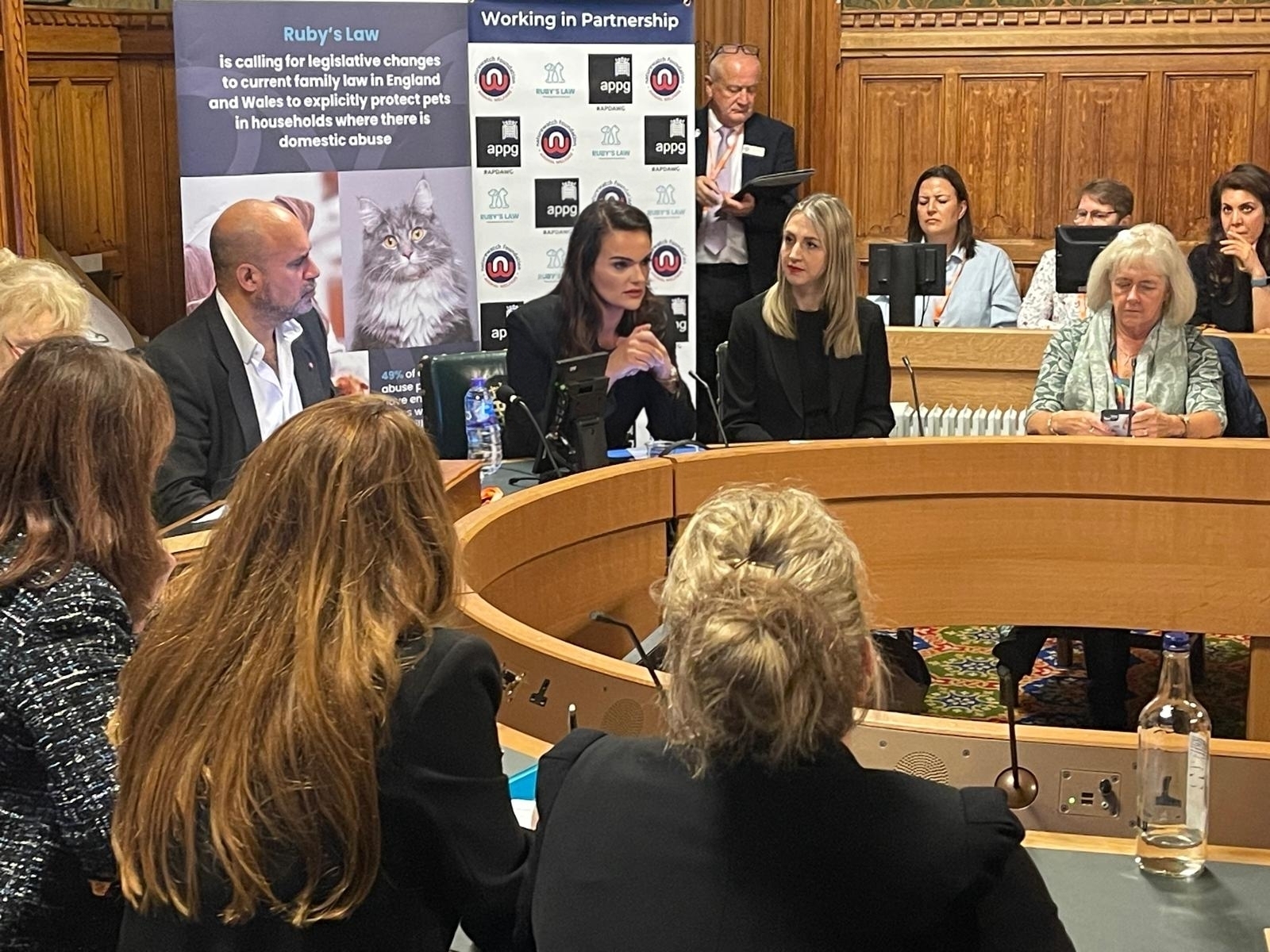
A Croydon barrister is spearheading a powerful campaign to reform UK domestic abuse law after discovering a shocking loophole that leaves pets, often dogs and cats completely unprotected from violent abusers.
Christina Warner, 43, a family law barrister, has launched Ruby’s Law, a proposed amendment to the Family Law Act 1996 and the Domestic Abuse Act 2021. If passed, it would, for the first time, explicitly recognise pets as victims of domestic abuse, ensuring they are included in Non-Molestation and Occupation Orders, and protected from being used as weapons of control.
Warner, who has spent years representing survivors of domestic abuse, said she could no longer ignore the pattern she was seeing.
“Time and again, I have represented victims who were terrified to leave because their abuser had threatened to harm their pets,” she said. “It’s an invisible form of control that traps people in dangerous situations. Pets are not property, they are family.”
Her campaign is named after Ruby, her late Persian cat who passed away in 2023, who she describes as the “beating heart” behind her mission.
“He beat our dog for an hour because she ran off at the park. I heard her screaming, then silence”
“After the hardest days in court, I’d come home to Ruby,” she said. “She reminded me that compassion and safety should extend to all beings, human and animal alike. Ruby’s Law is her legacy.”
Every year, more than 2.3 million adults in England and Wales experience domestic abuse but behind many of these cases lies a darker truth: abusers often turn their cruelty on animals.
A Dogs Trust report found that 97% of victims in abusive households also saw their pets harmed or threatened, and in nearly half of those cases, the animals were killed.
Shelly, 37, said, “He beat our dog for an hour because she ran off at the park. I heard her screaming, then silence. When I walked in, she was lying there, barely breathing.”
Ann, 38, said, “He used to throw things into my fish tank. One day, because I was late home, he poured bleach into the water. I had to sit there and watch them die.”
Emma, 34, described how her husband poisoned the children’s chickens with weed killer, while another survivor, Tami, 25, said her partner refused to feed or water their cats while she was in hospital. “It was his way of punishing me,” she said.

While the Domestic Abuse Act 2021 recognises coercive, emotional, and psychological abuse, it does not explicitly identify pet abuse as a form of control. Similarly, the Family Law Act 1996 can prevent an abuser from returning to the home, but cannot stop them from reclaiming, harming, or threatening family pets.
Warner said this oversight leaves survivors exposed to continued manipulation. “Abusers often keep legal ownership of the pet even after being removed from the home. They can threaten to take the animal or hurt it, and under current law, there’s little a victim can do. That’s a devastating gap that must be closed.”
Ruby’s Law would ensure pets are explicitly protected within protective and occupation orders. Under Warner’s proposal pets would be included in Non-Molestation Orders, preventing abusers from harming or threatening them. Victims would be granted custody of their pets under Occupation Orders.
Any breach involving harm or threats to a pet would become a criminal offence, punishable by up to five years’ imprisonment and The Domestic Abuse Act 2021 would be updated to classify pet abuse as coercive control.
“Many victims stay in abusive relationships simply because they can’t bear to leave their pets behind,” said Warner. “Ruby’s Law would give them the confidence to seek help, knowing their animals will be safe.”
“He said he’d kill the dog if I left. When I learned someone could look after her, that’s when I finally got out”
The emotional toll of pet abuse is profound. Studies show survivors whose abuser targeted animals endure an average of 50 violent incidents before seeking help, compared to seven for those without such abuse.
Children who witness harm to pets often develop post-traumatic stress disorder, anxiety, and trust issues. One woman from Luton said she only escaped her abusive partner when she discovered a foster scheme for pets saying.
“He said he’d kill the dog if I left. When I learned someone could look after her, that’s when I finally got out.”
Warner said these stories underline the urgency of reform, she said, “The link between animal cruelty and domestic abuse is undeniable. Scotland, Canada, and several U.S. states already recognise pet abuse as coercive control. England and Wales must catch up.”
Ruby’s Law would bring the UK in line with places like California, Maine, and British Columbia, where courts routinely include pets in restraining or protection orders.
Warner’s proposal also calls for more pet-friendly refuges, so survivors don’t have to choose between safety and their animals. Training for police and prosecutors to recognise pet-related coercion, and clear legal mechanisms to stop abusers from reclaiming pets after conviction.

“This isn’t just about animal welfare,” Warner said. “It’s about justice, empathy, and understanding the full extent of abuse. Pets are family — and it’s time the law treated them that way.”
Warner, who recently spoke at the All Party Parliamentary Working Group on Dog Welfare, is calling on MPs to back Ruby’s Law, warning that every day without reform puts lives, both human and animal, at risk.
“Ruby’s Law will save lives. It will empower survivors to break free, protect innocent animals, and hold abusers fully accountable. We can’t call ourselves a nation of animal lovers while allowing this loophole to persist.”
Ruby, the cat who inspired the campaign, passed away earlier this year. Warner says the fight continues in her name.
“Ruby represented unconditional love and resilience, qualities I’ve seen in every survivor I’ve ever met. This law is her legacy.”
Ruby’s Law is now gathering parliamentary and public support.
This is a guest post by Hayley O’Keeffe. Want to write for us? Visit www.dogstodaymagazine.co.uk/essay-submission or email editorial@dogstodaymagazine.co.uk.


